01 — THE NEED THE SYSTEM SERVES
Some places possess a character strong enough to determine how hospitality should exist within them. Their topography, climate, vegetation, geology, views, material culture and patterns of movement are not background conditions. They are the intelligence of the place.
Conventional hospitality often begins with a product and then adapts it to a site. A room type is repeated, a resort plan is organised, infrastructure is imposed and the landscape is shaped around the operating model. The result may be attractive, but the place can become a setting for hospitality rather than the source of it.
CONTEXTIO exists to serve the opposite condition. It is the Governed Hospitality System of Embeddedness — hospitality that belongs to the place because the place itself has generated the project.
The need is not tied to one geography or architectural style. It appears wherever a site is distinctive enough that reproducing a generic hospitality formula would diminish rather than reveal its value.
02 — THE HOSPITALITY CONCEPT
Embeddedness translated into hospitality produces a specific form: low-density, site-generated, spatially varied and inseparable from the landscape that gives it meaning.
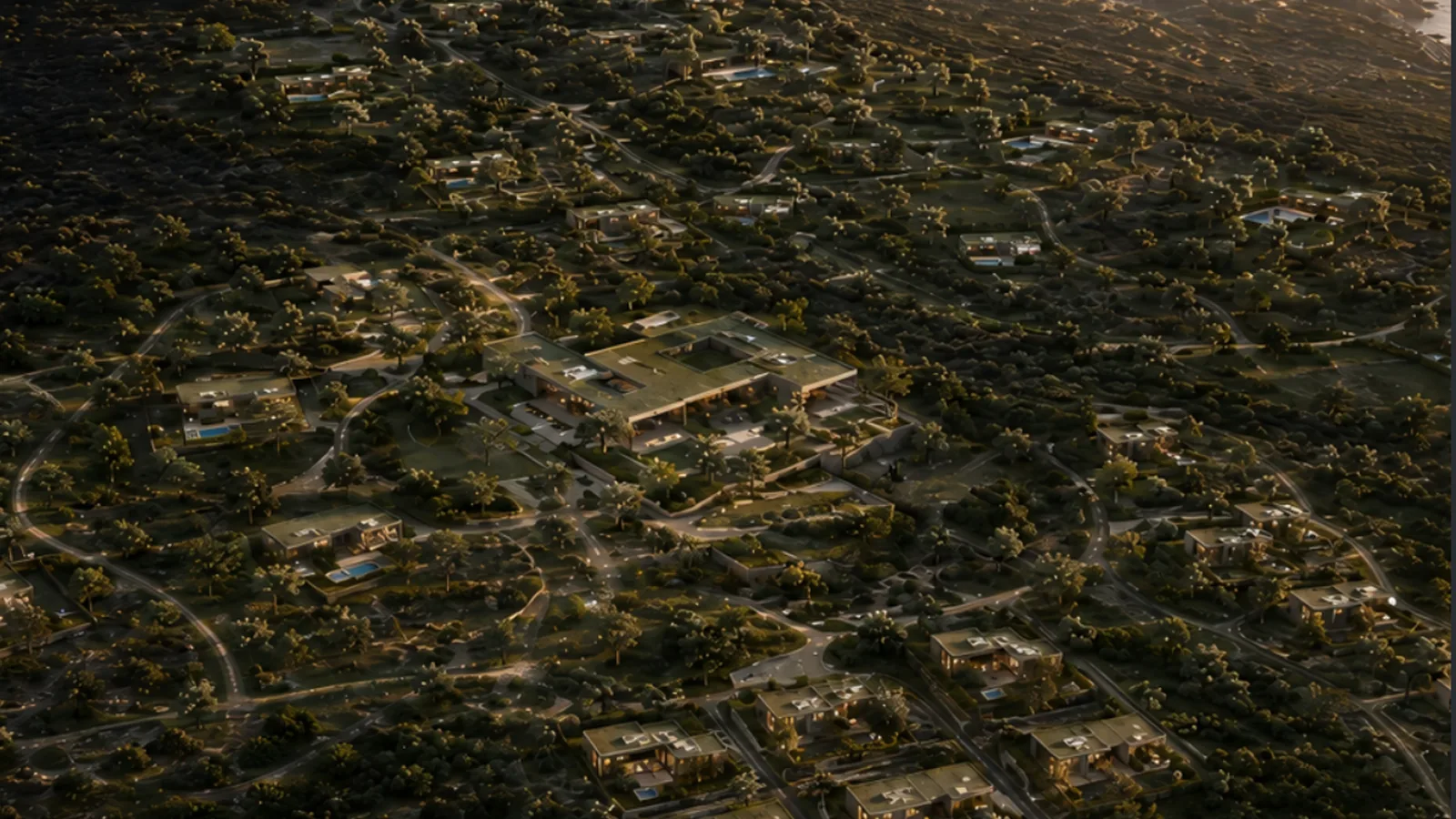
Every CONTEXTIO project is organised through one Main House and a field of Landscape Pavilions. The Main House is the collective hospitality heart — arrival, social life, gastronomy and other shared functions where appropriate — but it remains subordinate to the site. Landscape Pavilions provide private accommodation and respond individually to their own micro-sites rather than to a transferable architectural prototype.
Topography can change placement. Climate can change thresholds. Vegetation can create privacy. Views can determine orientation. Geology and local material intelligence can influence construction. The project remains coherent because the relationship between hospitality and place is consistent, not because the buildings look the same.
The concept can be stated in one line: the place determines the hospitality.
03 — THE ASSET AND ITS PREFERRED TERRITORIAL CONTEXT
CONTEXTIO is one Governed Hospitality System with one hospitality typology: one Main House and 20–50 Landscape Pavilion keys distributed according to the carrying capacity of one specific site. Within that same project, three positioning grades may coexist. They change density, private exterior territory, amenity intensity and economic positioning — not doctrine or typology.
- CONTEXTIO Select: the most compact grade, preserving Embeddedness with meaningful private exterior space and no private pool or jacuzzi.
- CONTEXTIO Luxury: a more generous grade with greater territorial separation, approximately 250 m² of private exterior landscape and a private jacuzzi.
- CONTEXTIO Upper Luxury: the most territorially rare grade, with exceptional privacy, approximately 1,000 m² of private exterior landscape and a private pool.
- All three grades remain Landscape Pavilions within the same CONTEXTIO project and may coexist on the same site.
- The grade follows the quality of the micro-site, privacy and spatial rarity; it is not created by finishes or amenity specification alone.
- The final key count always follows site carrying capacity. The authorised 20–50-key envelope is a boundary, not a development target.
The grades are intentionally not separate typologies. A more contained micro-site may support Select, a more private landscape position may support Luxury, and an exceptional edge, clearing, rock formation, elevated terrace or other rare condition may justify Upper Luxury. One site can therefore produce several levels of hospitality value without being divided into separate resorts or products.
| POSITIONING GRADE | OFFICIAL TERRITORIAL AND PHYSICAL POSITION |
|---|---|
| CONTEXTIO Select | Reference density 0.10–0.20 ha/key. More than 100 m² private exterior garden or landscape space. No private pool or jacuzzi. |
| CONTEXTIO Luxury | Reference density 0.30–0.40 ha/key. Approximately 250 m² private exterior landscape including a private jacuzzi. |
| CONTEXTIO Upper Luxury | Reference density 0.50 ha/key and above. Approximately 1,000 m² private exterior landscape including a private swimming pool. |
The density references are territorial planning metrics, not dedicated land parcels attached to individual pavilions. They establish the minimum territorial provision required for the proposed grade mix across the project as a whole. Private exterior space is contained within that overall site calculation rather than added on top of it.
For example, 10 Select keys at the minimum reference require 1 hectare, 10 Luxury keys require 3 hectares and 5 Upper Luxury keys require at least 2.5 hectares: a minimum reference site of 6.5 hectares for 25 keys. A more balanced application will often require more land, and topography, ecology, access, infrastructure or privacy may require a larger site or lower capacity.
CONTEXTIO is globally applicable where a site has enough real territorial character to generate the project. Mountain, forest, coastal, valley, rocky or arid, cultivated, lake and river landscapes may all qualify. The landscape type does not create a new typology; the site itself determines the architectural response.
04 — WHAT MAKES THE SYSTEM DIFFERENT
Several established hospitality categories occupy landscape settings. CONTEXTIO differs because landscape is not a setting, theme or view commodity: it is the causal structure from which the project is derived.
| ADJACENT CATEGORY | HOW CONTEXTIO DIFFERS |
|---|---|
| Conventional resort | A resort usually begins with a programme, amenity structure and operating plan. CONTEXTIO begins with the site and allows the programme and spatial structure to follow. |
| Eco-lodge | An eco-lodge may reduce environmental impact or adopt nature-based positioning. CONTEXTIO additionally requires the site to generate the architecture, movement, privacy and hospitality configuration. |
| Luxury villa resort | A villa resort can offer privacy and private amenities but normally repeats a transferable accommodation product. CONTEXTIO Landscape Pavilions are derived from their micro-sites and need not repeat one prototype. |
| Landscape hotel | A landscape hotel may achieve strong visual integration. CONTEXTIO goes further by making the site the governing source of spatial, operational and economic decisions. |
| Nature retreat | A retreat often adds programme, wellness or transformation as the central proposition. CONTEXTIO does not prescribe how the guest should use the place; Embeddedness is the condition, not an activity programme. |
Stated positively: CONTEXTIO is a low-density hospitality system in which one Main House, dispersed Landscape Pavilions, private exterior environments, movement, operations and economics are organised by the real intelligence of the site. The system is repeatable; the physical answer is not.
05 — HOW THE SYSTEM OPERATES
The operating logic follows from the dispersed, site-generated structure and remains deliberately subordinate to place.
- The Main House provides the principal shared hospitality anchor without becoming a dominant resort object.
- Service is precise, discreet and capable of reaching dispersed Landscape Pavilions without intrusive roads, visible staging or constant staff presence.
- Arrival, luggage, housekeeping, dining, maintenance, mobility and emergency response are adapted to real distances, gradients, climate and site conditions.
- The operator adapts its standards to the site-derived configuration rather than reorganising the project around a generic operating prototype.
- Select, Luxury and Upper Luxury grades may operate together within one project while retaining coherent service, identity and guest experience.
An operator is appointed by the Project Owner and remains responsible for commercial and operational execution — including rate strategy, distribution, staffing, service and daily management — within the established CONTEXTIO relationship between site, Main House, Landscape Pavilions, grade mix and Embeddedness.
06 — THE ECONOMIC LOGIC
Embeddedness is a Condition of Life. It can also support viable hospitality assets because scarcity, privacy, site distinction and pavilion differentiation can create value without relying on amenity volume or architectural repetition. The three grades provide more than one pricing position within one coherent project while the site remains the common source of value.
| CHARACTERISTIC | ECONOMIC CONSEQUENCE |
|---|---|
| Site-derived scarcity | Pricing is supported by qualities that cannot be reproduced unchanged elsewhere: micro-site, privacy, outlook, terrain, material character and the integrity of the overall landscape. |
| Controlled territorial density | The grade mix creates a disciplined relationship between inventory and land. Additional keys are not automatically valuable if they weaken privacy, landscape integrity or rate defensibility. |
| Three coherent positioning grades | Select, Luxury and Upper Luxury allow different rate positions within one project without creating separate typologies, compounds or competing identities. |
| Private exterior value | Increasing private landscape, jacuzzi or pool provision is tied to grade and micro-site quality rather than indiscriminate amenity escalation. |
| Main House concentration | Shared hospitality is concentrated in one coherent heart rather than multiplied through unnecessary outlets and resort infrastructure. |
| Project-specific underwriting | ADR, occupancy, CAPEX, OPEX and EBITDA are recalibrated to actual site complexity, grade mix, operator, market, access and construction conditions. |
These characteristics explain the economic logic; they do not predetermine performance. CONTEXTIO currently uses institutional rate corridors by grade as reference rather than as guaranteed outcomes: Select approximately €350–500 blended ADR, Luxury approximately €500–700, and Upper Luxury approximately €700–950+, with project-specific evidence controlling the final underwriting. Site carrying capacity remains superior to revenue maximisation.
07 — WHAT THE SYSTEM PROVIDES
CONTEXTIO is not an idea awaiting development. It is a complete institutional hospitality system, developed before any individual project and made available for project-specific application through the applicable GHS Project Package and dedicated GovHos AI environment.
| DOMAIN | WHAT IS ALREADY DEFINED |
|---|---|
| Hospitality concept | Embeddedness translated into one Main House and 20–50 Landscape Pavilion keys whose physical expression is generated by one specific site. |
| Doctrine and identity | The founding doctrine of Embeddedness, its protected relationships and the institutional identity through which CONTEXTIO is recognised without imposing one architectural style. |
| Territorial logic | How territory and site are assessed for topography, climate, vegetation, geology, water, views, material conditions, movement, privacy and carrying capacity. |
| Typology and grades | One CONTEXTIO typology with three positioning grades — Select, Luxury and Upper Luxury — capable of coexisting within the same project without becoming separate typologies. |
| Architectural and interior principles | The principles through which Main House and Landscape Pavilions are derived from micro-site conditions rather than transferable prototypes. |
| Operational logic | The dispersed-service model, Main House role, movement discipline, landscape care and operating posture required to keep hospitality subordinate to place. |
| Economic framework | The density, scarcity, grade, ADR and project-specific underwriting logic through which site integrity and asset performance are reconciled. |
| Operator compatibility | What an operator must be capable of, including distributed hospitality, brand discipline, landscape-sensitive servicing and operation across the selected grade mix. |
| Structural governance | How Embeddedness, site carrying capacity, typological integrity, grade logic and protected relationships remain coherent across owners, operators and project stages. |
| Implementation and continuity | The methods for applying, validating and maintaining CONTEXTIO from site qualification through design, opening and long-term asset evolution. |
The reader of this document is not being shown a concept to be developed. They are being shown one complete hospitality system whose architecture changes because the site changes, while the governing relationship between hospitality and place remains protected.